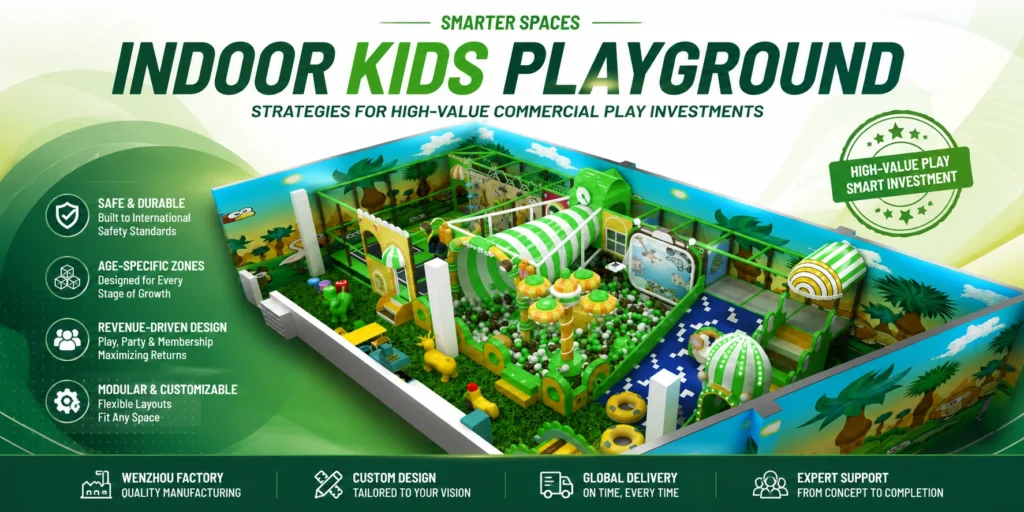
Before you book a factory visit or request quotes from a Wenzhou playground supplier, you need clarity on what the market actually buys. The U.S. indoor play sector expects far more than a few slides and ball pits.
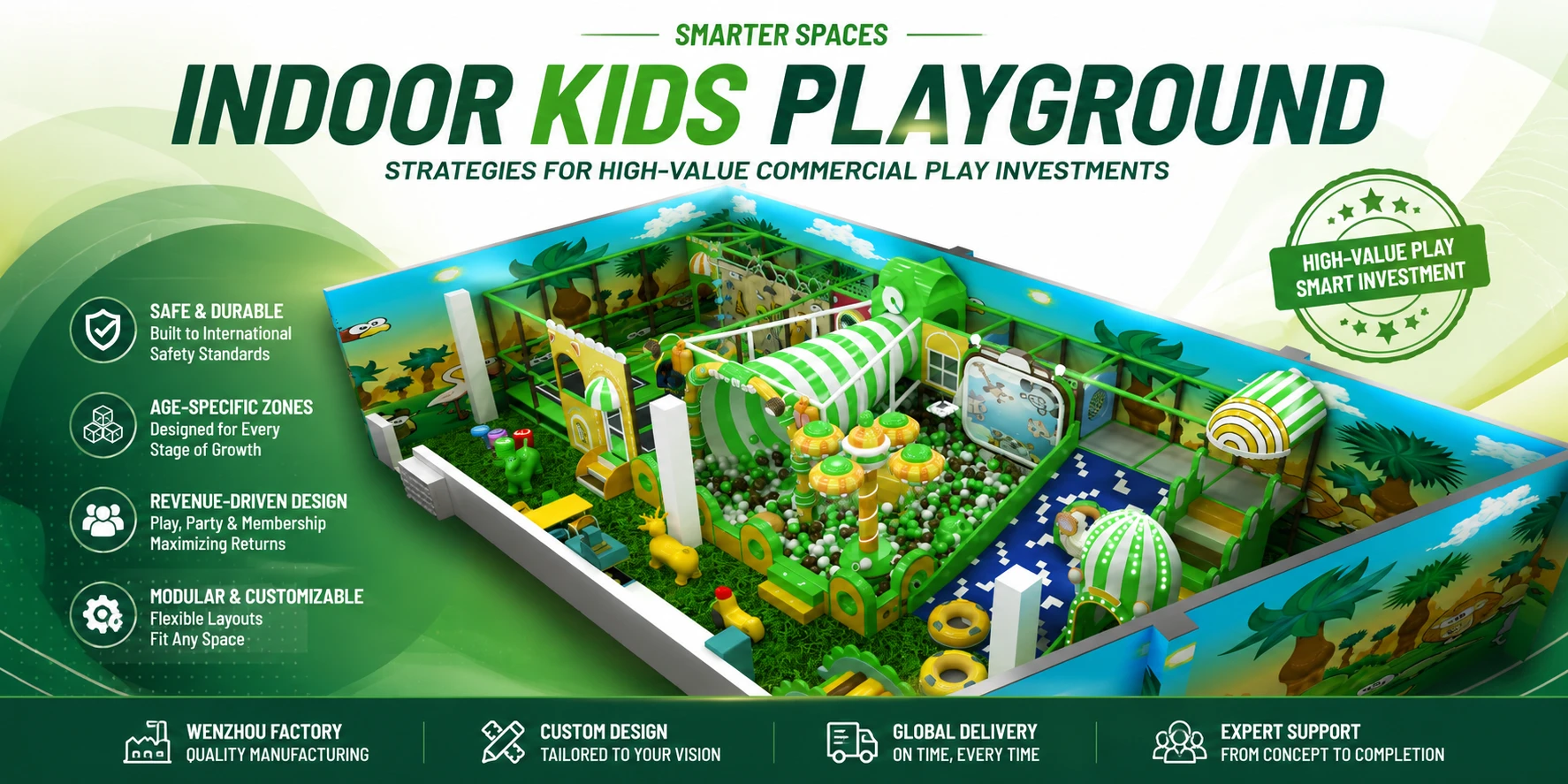
An indoor kids playground is a commercial indoor space featuring age-specific play structures, soft play elements, and interactive attractions that attract family visits and generate recurring revenue.
The sections ahead move from market knowledge to equipment-sourcing decisions: venue formats, cost planning, age-specific design, core attractions, and revenue streams.
Understanding the Indoor Kids Playground Market: Venue Formats and Equipment Demands
Venue format dictates equipment specification before price or square footage does. Four distinct formats appear repeatedly across U.S. listings, and each creates different fabrication demands.
- Open play centres (Play & Party Co.) – soft play modules, ball pits and low-level slides; layouts need to flex for walk-in play.
- Family entertainment centres (Chuck E. Cheese) – themed soft play, interactive games and party zones; equipment faces high rotation and daily cleaning.
- Jump parks – trampolines, foam pits and climbing walls; require 5m-plus ceilings and structural steel frames.
- Soft play cafes – compact foam modules for toddlers; low fall heights, wipe-clean surfaces and clear sightlines from seating areas.
Those format differences matter when you approach the Wenzhou playground equipment hub. One factory may excel at steel trampoline frames, another at moulded foam modules. Verify reference builds for your target format, not just a general product range.
Format choice also drives your cost plan, which is the next section to review before shortlisting suppliers.
Indoor Kids Playground Cost Planning: From Soft Play Zones to Multi-Level Attractions
Budget first: a commercial indoor kids playground typically costs $20-$50 per square foot for equipment, with total project spend running from $40,000 for a compact soft play zone to over $1.5 million for a large multi-level attraction. Five drivers shape that figure: total square footage, ceiling height, attraction type, customisation level, and safety surfacing.
| Scale | Typical area | Attraction mix | Equipment budget |
|---|---|---|---|
| Small soft play centre | 1,000-3,000 sq ft | Foam modules, ball pit, toddler slide | $30-$50/sq ft ($40k-$150k total) |
| Mid-size FEC | 5,000-15,000 sq ft | Multi-level structure, trampolines, soft play | $25-$40/sq ft ($150k-$500k total) |
| Large multi-level attraction | 20,000+ sq ft | Climbing towers, high slides, interactive games | $20-$35/sq ft ($500k-$1.5M+ total) |
Ceiling height matters most. Standard 3-metre rooms suit soft play; 6-metre-plus ceilings allow tall towers and trampoline zones. Custom themes and premium safety flooring add 15-30% on top.
Sourcing playground equipment in Wenzhou China reduces upfront CAPEX because modular manufacturing and lower labour costs compress per-unit pricing. Balance that saving against shipping time and freight, and build both into your project calendar.
Age-Specific Indoor Kids Playground Design: Toddler Zones, Preschool Areas, and Big-Kid Structures
Age zoning is not optional in a commercial indoor kids playground. It is a safety system and a marketing feature. Venues such as the PBS Kids Play Area earn repeat visits because parents trust a layout that matches their child’s stage. Multi-age facilities in the SERP results confirm the same pattern: separate zones keep toddlers safe and older children engaged.
Toddlers (0–3) — foam soft play, low steps, sensory panels, crawl tunnels. Fall heights stay below 60 cm, and sightlines remain open for supervising adults.
Preschoolers (3–5) — mini slides, ball pits, imaginative play houses. Equipment spacing must allow quick adult access, and edges require rounded foam cladding.
School-age (6+) — climbing walls, obstacle courses, high slides. Taller structures demand impact surfacing and physical separation from younger zones.
Each zone changes factory production drawings, from foam cutting to steel fabrication. Before ordering, ask a Wenzhou indoor playground supplier which age-specific product lines they have actually built — a blank answer signals limited design capability.
Core Attractions and Equipment Mixes for Indoor Kids Playgrounds
For an indoor kids playground, age zoning shapes which attractions you buy, but seven types recur across U.S. SERP venues. Treat this list as your baseline checklist when discussing catalogues with shortlisted suppliers:
- Trampolines — steel frames, PVC jumping mats; ages 6-12 in high-ceiling jump parks.
- Soft play climbers — foam and PVC modules; toddlers 0-3 and preschool zones.
- Tall play structures — steel, nets and platforms; school-age climbers 6+.
- Ball pits — foam-lined bases, PVC balls; best for ages 2-6.
- Slides — steel or fibreglass; from low nursery runs to high spiral units.
- Interactive projection games — floor/wall systems; engages ages 3-10.
- Water features — treated splash pads and fountains; seasonal, space-dependent.
Match the mix to venue format. Party-centred centres favour themed soft play — SERP demand includes ‘superhero playground’ concepts — while a full FEC adds trampolines and arcades. Bring this list on a Wenzhou playground factory visit and check each category against production samples.
Indoor Kids Playground Revenue Streams: Party Packages, Memberships, and Equipment Priorities
Revenue evidence from Wichita venues points to three streams, each with distinct layout demands:
- Walk-in admissions — open play needs a flexible floor plan, so position the central structure where several age groups can play under clear sightlines.
- Birthday party packages — Play & Party Co. and similar centres sell private rooms. These need separate entries, themed backdrops, and acoustic separation, so design them as independent modules.
- Memberships — FECs rely on repeat visits, which demands durable equipment. Foam density, stitching, and steel connections must survive weekly use.
These models shape what you ask a Wenzhou kids playground factory to draw. A multi-use central structure with a separate party entrance requires different production drawings than a single-purpose layout. Confirm modularity before ordering — the China playground sourcing hub builds from CAD, and revisions cost time.
About JQ Playground – wenzhouplayground.com
JQ Playground (Wenzhou Jiqi Amusement Equipment Co., Ltd.) is a children’s playground equipment manufacturer founded in 1993. The company provides design, customization, large-scale manufacturing, sales, installation guidance, and after-sales support for outdoor playgrounds, indoor playgrounds, soft play, water playgrounds, PE board playgrounds, kindergarten furniture, outdoor fitness equipment, pet playgrounds, and playground facilities. Approved company facts include 180+ employees, a large Wenzhou production base, 20+ production lines, 55 production machines, ISO/BSCI/EN1176/EN71/ASTM/CPC/CPSIC certification references, 100+ patents, free design support, OEM/ODM capability, trial installation before shipping, export experience, and one-year quality warranty.