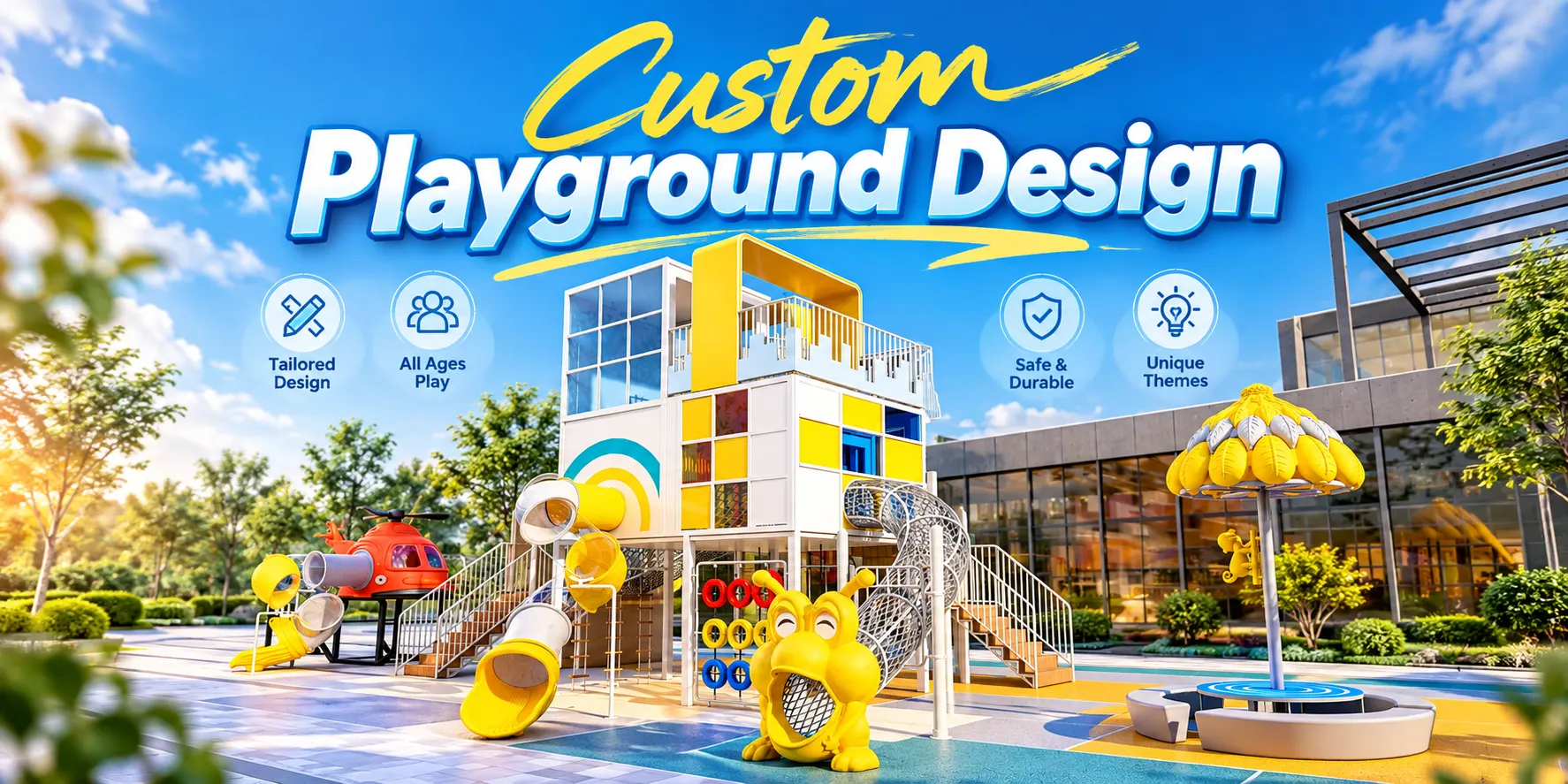
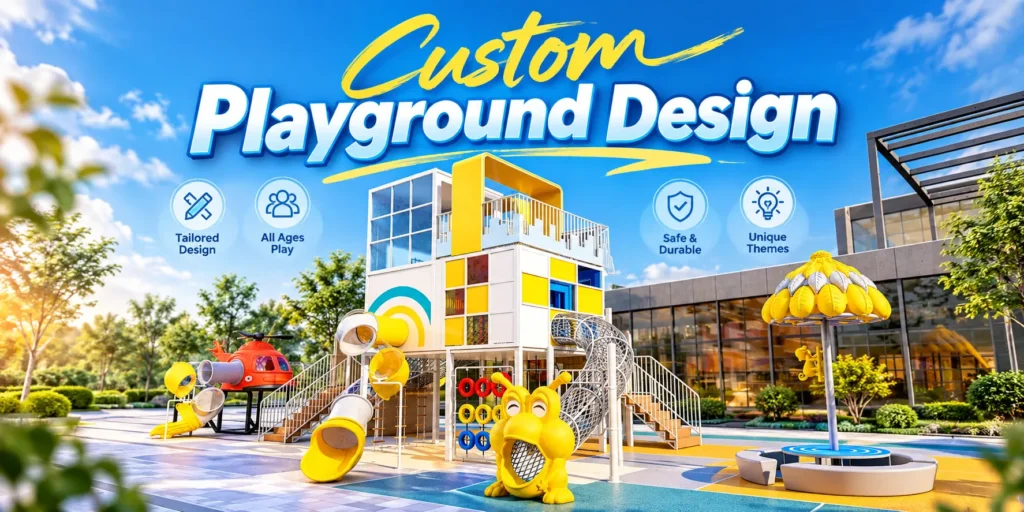
Specifying a play area from a standard catalogue rarely ends well. A 480 m² site takes a 320 m² module, the age bracket moves from 3–5 to 5–12, and the drawings no longer match the ground. Buyers comparing Wenzhou playground quotes then wait weeks for a layout that fits. Custom playground design closes that gap before the order, not after installation.
Custom playground design is the process of planning a play space around a specific site, age group and user capacity, then specifying bespoke equipment, layouts and safety surfacing to match. It starts with site measurement and a concept plan, then moves through structural engineering, material selection, production drawings, batch manufacturing and installation. The deliverable is a drawing set, a bill of materials and equipment sized to the real footprint rather than a catalogue module, with fall zones, access points and inspection records agreed before production begins.
How that process runs, from first sketch to shipped equipment, comes next.
How Custom Playground Design Works
Custom playground design runs as a sequence. Each step produces a document you can check before the next one starts.
- Site and user audit. Record age group, space and fall height; these set the surfacing depth and safety zone.
- Concept layout. Fit decks, slides, climbers and panels to the measured area and your colour brief.
- Engineering drawings. Fix post spacing, deck heights and a component schedule you approve before tooling.
- Production and inspection. Check welds, coating thickness, hardware counts and packaging against approved drawings.
Approve the safety-zone drawing before tooling. Layout changes after production starts add cost and delay.
What each component does
Posts and decks carry the structural load. Slides, climbers and panels set play value and age suitability. Clamps and fasteners hold the assembly together, so specify material grade and corrosion finish in the RFQ.
Those component groups are what the next comparison sorts by product type.
Custom Playground Design Components and Product Types
Catalogue entries for a Wenzhou outdoor playground usually cluster into four families. Most builds combine two or three, so compare by family before pricing.
| Product type | Core components | Check before RFQ |
|---|---|---|
| Modular steel systems | 114 mm posts, decks, clamps, slides | Post wall thickness (2.5–3 mm); powder-coat build |
| Timber structures | Robinia or laminated pine beams, steel fixings | Timber grade; rot treatment; bolt grade |
| Swing and rotator units | Frames, chains or ropes, bucket, flat or nest seats | Seat type by age band; bearing rating |
| Soft play and surfacing | Foam blocks, padded panels, EPDM tiles | Tile thickness (20–50 mm); fall-height rating |
- Age band first. 2–5 years suits deck heights of 0.6–1.2 m; 5–12 years often runs 1.5–2.5 m.
- Fixings. Specify stainless A2 or A4 bolts with tamper-resistant heads.
- Accessories. Roofs, panels and climbing holds are counted per unit, not per project.
- Finish. Confirm RAL colour codes and slide material thickness.
Each family suits different applications, which is where site conditions take over.
Typical Applications for Custom Playground Design
The application usually narrows the choice faster than the product catalogue does.
- Early years and nurseries: decks under 600 mm, rounded caps and soft-fill surfacing for under-5s; ask for impact-test evidence matching the stated fall height.
- Primary schools and public parks: climbing nets and slides aimed at the 5–12 age band, where batch demand often runs 3–10 units and colour or sticker consistency across the run matters.
- Hospitality and indoor retail: Wenzhou indoor playground fit-outs commonly occupy 60–100 m², so foam density and vinyl thickness drive the quote, not the frame.
- Wenzhou soft play supplier enquiries: specify ball-pool depth, padding thickness and panel module sizes before sampling.
| Application factor | Action before RFQ |
|---|---|
| Age band | Match deck and fall heights to the user group |
| Footprint | Send a site plan with clearances and access widths |
| Batch size | Request unit pricing at 3, 10 and 30 units |
| Quality evidence | Ask for material sheets, joint samples and pre-shipment photos |
With the application fixed, the next question is how those requirements move through production.
Custom Playground Equipment
Drawings or a physical sample set the baseline. Tooling starts only once both sides agree on dimensions, material grade, colour and edge treatment. The table below maps what you supply at each stage against what comes back.
| Stage | Your input | Manufacturer output |
|---|---|---|
| Concept | Site plan, age group, footprint | Feasibility note, 2D layout, safety-zone check |
| Quotation | Quantity, packaging style, delivery window | Itemised quote, tooling cost, lead time |
| Sample | Sign-off on the pre-production unit | Retained reference sample with sample number |
| Packaging | Carton or pallet spec, logo placement | Packing list, carton marks, container load plan |
| Batch inspection | Agreed checkpoints and AQL level | Batch report, component photos, defect log |
| Shipment | Forwarder details, shipping marks | Booking confirmation, loading photos, document set |
Inspection runs across every batch, not just the first. Weld quality, coating thickness, fastener torque and edge radius get measured against the retained sample, and records should cite that sample number so later queries are traceable. A Wenzhou playground factory visit lets you watch one check cycle in person. Process proof narrows the field; supplier fit decides it.
Top 10 Custom Playground Design Manufacturers and Supplier Fit
That fit test comes down to matching project risk to a supplier’s core strength. For a Wenzhou kids playground or wider China playground sourcing hub brief, the top 10 players fall into four types.
| Supplier type | Pros | Cons | Best fit |
|---|---|---|---|
| Full-scope custom manufacturers | Single accountability | Higher minimums | Large district rollouts |
| Design-led studios | Original concepts | Outsourced fabrication | Themed play spaces |
| Component specialists | Deep module expertise | Multi-vendor coordination | Upgrades and replacements |
| Regional fabricators | Fast local delivery | Limited testing capacity | Small community projects |
Score each shortlisted supplier on:
- Design flexibility against your concept’s deviation from catalogue.
- Safety evidence for the exact quoted configuration.
- Sample lead time and tooling cost transparency.
- Inspection consistency over three production runs.