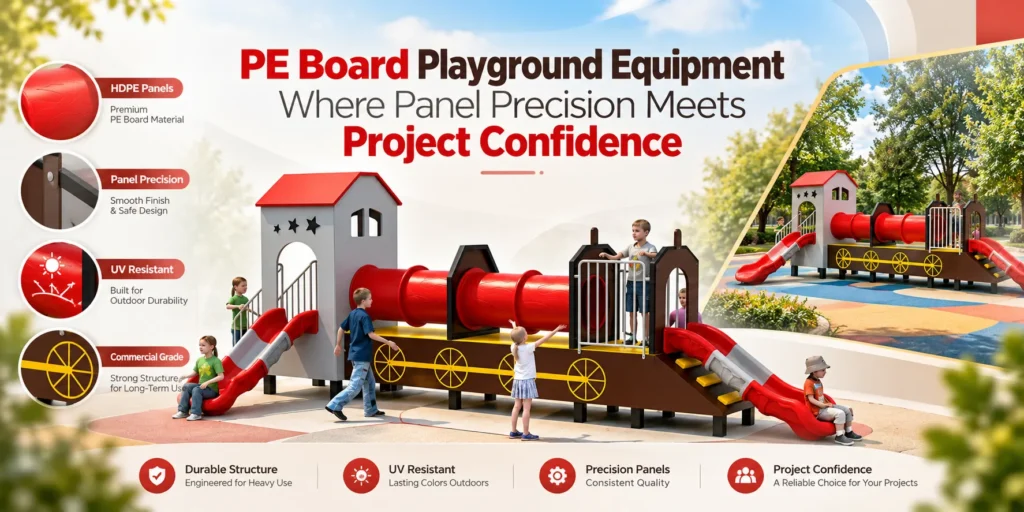
You have decided on PE board play equipment, but the first step is the hardest: sorting real factories from directory entries before you commit to a category, a supplier shortlist or a factory visit to Wenzhou.
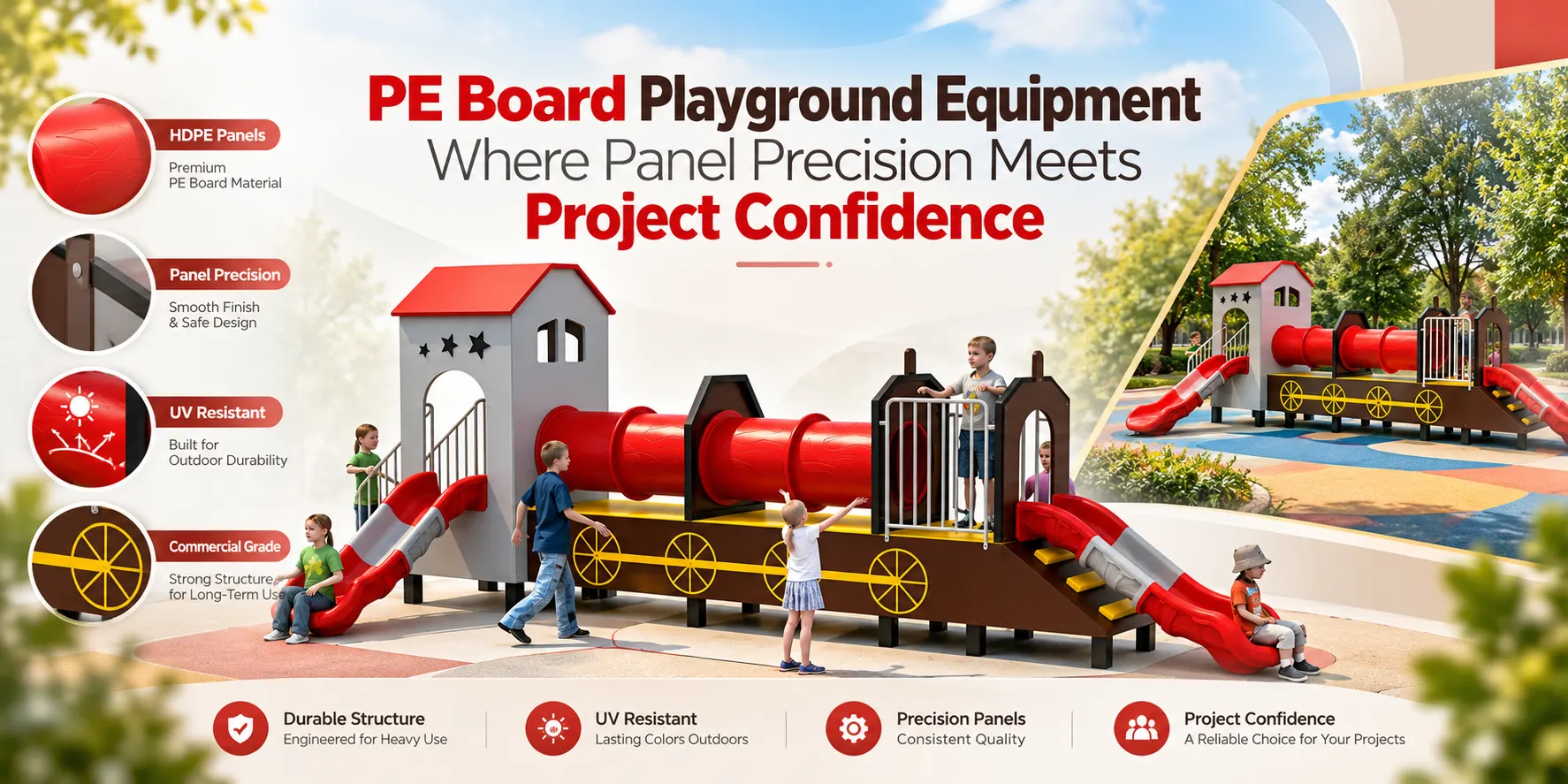
PE board playground manufacturing is the production of high-density polyethylene panels that are cut, routed and assembled into play panels, towers and climbers for commercial use. Panels are shaped on CNC routers, edged, then fixed to metal posts and decks to form weather-resistant play structures.
The sections below set out how supplier lists work, where panels sit in a playground range, and what to check before you shortlist.
How Manufacturer Lists Sort PE Board Playground Suppliers — and What They Leave Out
List pages group PE board playground suppliers in three broad ways: global “top 25” directories, country-level lists, and accessible-equipment variants. Ranking often follows paid placement, editorial pick or alphabetical order — not verified PE board capability. The at-a-glance fields are narrow:
- Headquarters location — country and city only, not the factory address.
- Founding year — age of the business, not years working with HDPE panels.
- Employee band — a 50–200 bracket, not production capacity.
- Product scope — categories listed, rarely panel thickness or board grade.
- Entity type — manufacturer or reseller, and not always stated clearly.
Treat inclusion as visibility evidence. A listing cannot confirm that a supplier cuts, routes or assembles panels in-house. Verify that before comparing how panel products sit inside a wider playground range.
Where PE Board Panels Fit in a Commercial Playground Range
Supplier collection pages place PE board play in a panel sub-range, alongside towers, climbers, slides and spinners. Within that sub-range you will see drum panels, music walls, activity boards and sensory panels grouped by play type or bay count. PE board playground manufacturers organise browsable ranges by structure — tower, climber, slide, spinner — with panel options listed as add-ons or standalone units.
Panels attach to post-and-deck systems: a panel spans between two posts, bolts to a deck edge, or forms part of a freestanding frame. Use-zone filters split collections next — toddler, junior and inclusive — so a compact sensory panel and a three-bay music wall do not share a shortlist. Many ranges flag inclusive panel play: low-level, transfer-friendly panel units are sold as the accessible layer of a Wenzhou outdoor playground. The range view narrows the category; spec fields decide the comparison.
Two PE board play units can photograph identically and still differ by half a metre of use zone and a two-year age band. The comparison starts on the pe board playground manufacturer’s product page and in the downloadable spec package, where the same fields repeat across every model — that repetition is what lets you line units up side by side instead of by image.
| Field | What it tells you | Why it changes the comparison |
|---|---|---|
| Use-zone dimensions | Total footprint including fall space | Turns a 2 m unit into a 6 m site allocation |
| Age group | Designed user band (toddler, junior, teen) | Fixes panel height, grip size and supervision needs |
| Occupancy / capacity | Users the unit is rated for simultaneously | Separates a queue-forming centrepiece from a fill-in panel |
| Panel and component count | Number of play panels, posts and connectors | Drives assembly hours and spares volume |
| Post size | Diameter and wall of the structural post | Determines deck and roof options and footing depth |
| Deck height and configuration | Platform levels and how they connect | Sets slide entry heights and stepped vs single-level layouts |
| Assembly format | Flat-pack, pre-assembled sections, bolt-together | Changes crate count, crane need and on-site labour |
Use-zone and age group usually eliminate half a shortlist before price enters the conversation. A 7.5 × 7.5 m fall envelope will not fit a fenced toddler yard, whatever the panel artwork suggests. Lock those two fields first, then compare the rest. Which fields you weight shifts with the setting.
Matching PE Board Playground Units to Parks, Schools and Daycares
The setting decides the panel run before the artwork does. Ask for the same PE board playground unit configured for the site, not the catalogue default.
- Public parks: open panel runs and wider circulation zones suit mixed traffic; a freestanding music wall can sit outside the main tower footprint so passers-by do not cut through the fall zone.
- Primary schools: partly enclosed runs at a 1.2 m deck height give group play while keeping sightlines; an activity panel facing the building lets staff scan the yard from a doorway.
- Daycare and kindergarten yards: lower decks, say 0.6 m, with denser sensory panels for calmer play; a compact drum panel cluster works inside a fenced toddler area.
- Neighbourhood and community spaces: separate panel zones by age and keep a 1.5 m accessible route past the frame; a ramp-linked panel unit lets wheelchairs and buggies pass without entering the play area.
Once the setting is fixed, the next question is where the panel, post and coating supply sits.
Why Do PE Board Playground Manufacturers Cluster Around Wenzhou?
The Wenzhou kids playground supply base packs panel cutting, steel post fabrication and powder coating into the Qiaoxia and Yongjia districts, so one day of sampling can cover a panel specialist, a post fabricator and a coating line. Mould-making shops sit in the same radius, which shortens the gap between a routed panel design and a physical sample. For mixed-container orders, that density lets you consolidate panels, posts and hardware without long freight legs between stops.
Sequence a two- or three-day visit:
- Panel specialist — panel thickness, routing and edge finish.
- Post and hardware supplier — post section, clamps and fixing sets.
- Coating shop — colour and finish on fabricated steel.
Weigh cluster access against country-level supplier lists: a list confirms who exists, while a cluster shows whether they can sample, quote and load together. Keep both, in that order.
About JQ Playground – wenzhouplayground.com
JQ Playground (Wenzhou Jiqi Amusement Equipment Co., Ltd.) is a children’s playground equipment manufacturer founded in 1993. The company provides design, customization, large-scale manufacturing, sales, installation guidance, and after-sales support for outdoor playgrounds, indoor playgrounds, soft play, water playgrounds, PE board playgrounds, kindergarten furniture, outdoor fitness equipment, pet playgrounds, and playground facilities. Approved company facts include 180+ employees, a large Wenzhou production base, 20+ production lines, 55 production machines, ISO/BSCI/EN1176/EN71/ASTM/CPC/CPSIC certification references, 100+ patents, free design support, OEM/ODM capability, trial installation before shipping, export experience, and one-year quality warranty.