Planning an indoor play space is stressful when you cannot judge equipment quality from a photo alone. One overlooked safety detail can delay your opening for months and inflate your budget. The fix is a structured sourcing process: understand how parks are built, compare the components that matter, and ask suppliers the right questions before you commit.
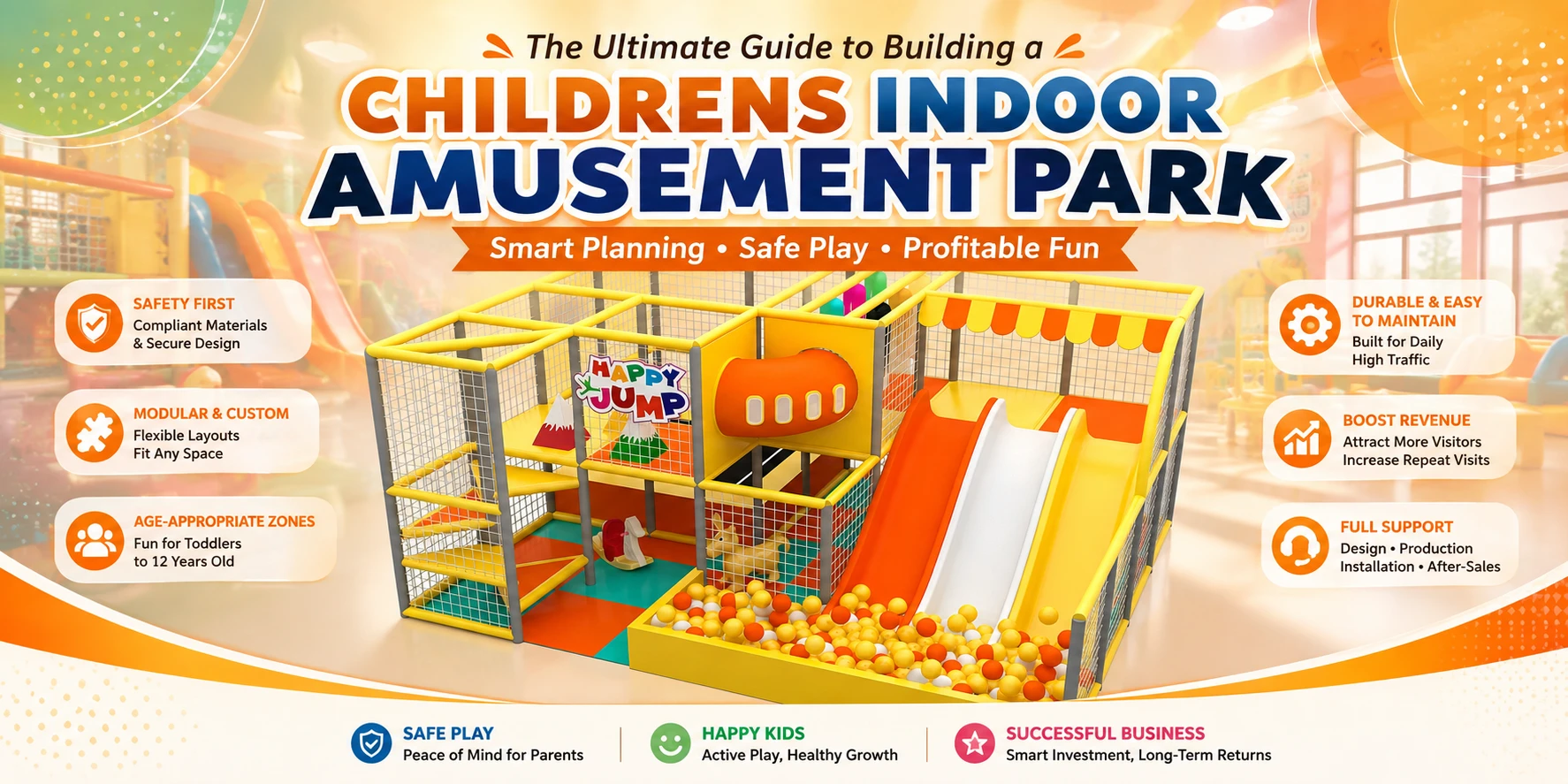
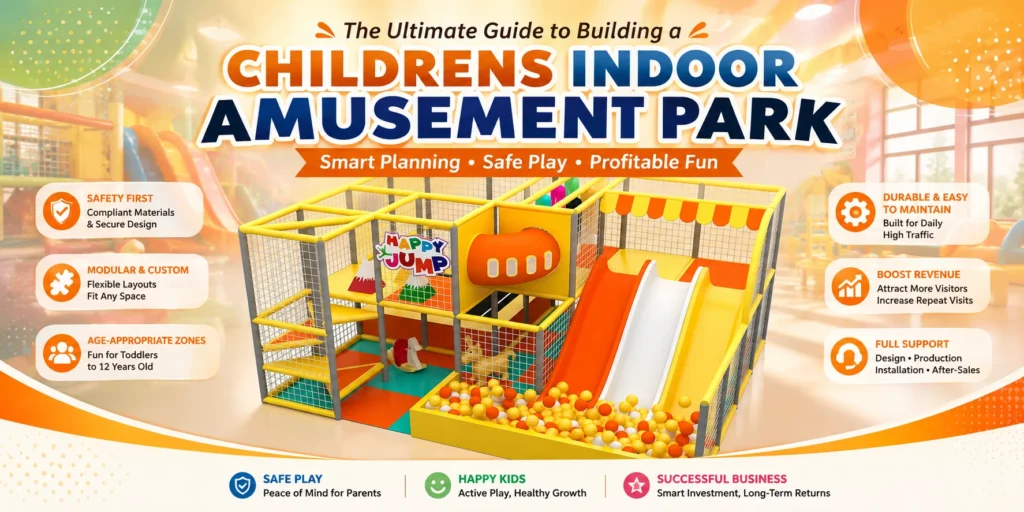
A childrens indoor amusement park is a supervised, weather-independent play facility designed for children, typically aged 0-12, featuring soft play structures, ball pits, slides, climbing frames, trampolines and themed zones inside a building. Unlike outdoor playgrounds, it operates year-round in a controlled environment with padded flooring, safety barriers and age-separated areas. Operators purchase equipment from specialised manufacturers who supply modular components, custom layouts, installation support and compliance documentation.
Read on to learn how these parks operate and which supplier checks matter before you send an RFQ.
How Childrens Indoor Amusement Park Works
A childrens indoor amusement park runs on timed sessions rather than free flow. The core sequence:
- Admission — tickets checked, wristbands issued, height rules confirmed.
- Zone entry — children separate into toddler soft play, slides, ball pits, and ride areas.
- Supervised play — staff monitor blind spots and enforce ride height limits.
- Rotation — sessions pause briefly for surface cleaning between groups.
Each stage links to a sourcing check. Zoning decides whether you need modular barriers; supervision demands sight-line drawings before fabrication; rotation requires washable, anti-bacterial materials.
Component roles
Soft play frames provide climbing value, slides add sensory feedback, and coin-op rides boost repeat visits. Specify component grade by expected daily visitor count — a 400-child park needs heavier duty hinges and matting than a 100-child site.
Buyer warning: ask for a zone-by-zone safety layout before quoting. An impressive ride layout with blocked sight lines can fail compliance.
Childrens Indoor Amusement Park Components and Product Types
Most “childrens indoor amusement park” RFQs treat a venue as one item, yet it is a kit of component systems, each with its own specification. Split your enquiry into these categories and compare each line before supplier selection.
| Component system | Product types to compare | Specification checks |
|---|---|---|
| Soft play structures | Foam blocks, A-frames, slides, crawl tubes | Foam density, cover grade, edge radius |
| Ball pools | Shells, safety surrounds, pool balls | Ball count per m², ball diameter, fire rating |
| Trampolines | Frames, springs, mats, enclosure nets | Spring count, mat tensile strength, net height |
| Motorised rides | Carousels, drop towers, interactive panels | Rider capacity, restraint type, operating voltage |
When you compare playground equipment in Wenzhou China suppliers, three details separate a workable quote from a costly one:
- Connector system. Ask whether modules bolt together or weld; bolted builds are simpler to extend and repair in later years.
- Cover material. Specify the PVC or PU leather grade, flame-retardant class and seam-sealing method before you request pricing.
- Control panels and wiring. Confirm whether electronics carry their own safety documentation and whether spare control parts are stocked.
Typical Applications for Childrens Indoor Amusement Park
The right build depends on where you operate, how many children pass through each day, and how exacting your local safety checks are.
- Malls and family entertainment centres. High visitor flows call for multi-level structures with separated entry and exit routes. Order spare panels from the same batch so later replacements match the original colour.
- Restaurants and cafés. A compact 20–30 m² soft play zone typically needs two or three modules. Keep the batch small and specify easy wipe-down surfaces for daily cleaning.
- Schools, nurseries and retail play areas. Under-5s zones need low fall heights, dense foam and rounded edges. Request batch photos that show consistent foam density before you order.
| Application factor | Action to take |
|---|---|
| Multi-level mall zone | Confirm fall-height calculations and supervisor sightlines |
| Multi-site rollout | Request phased delivery with identical colour batches |
| Destination market | Ask which safety standards the structure meets |
Take this application list with you when you shortlist suppliers, since it shapes the custom manufacturing brief that follows.
Custom Childrens Indoor Amusement Park Manufacturing and OEM Cooperation
Custom manufacturing starts with your design intent. Send drawings, CAD files, reference photos, or a physical sample; the factory then checks material choice, safety compliance, and structural feasibility before quoting. Confirm the pre-production sample, and batch production proceeds stage by stage.
| Stage | Buyer input | Manufacturer output |
|---|---|---|
| 1. Quotation | Drawings or sample, quantity, site dimensions | Feasibility check and itemised quote |
| 2. Sampling | Approved sample, logo or colour choices | Sample confirmation and production schedule |
| 3. Production | Inspection timeline, deposit | Inline checks and progress photos |
| 4. Dispatch | Final payment, shipping instructions | Batch inspection, packaging, shipment |
Inspection detail
Request pre-shipment checks on welds, edge smoothness, and joint stability. Photographic evidence at each stage also shortens later Wenzhou playground factory visit time, then supplier fit decides your final shortlist.
Top 10 Childrens Indoor Amusement Park Manufacturers and Supplier Fit
Shortlisting for a childrens indoor amusement park works best when you match supplier type to project stage. Full-service builders suit new venues and turnkey fit-outs; specialist soft-play workshops suit refurbishment budgets; OEM factories give established operators layout control. Trading companies add convenience but often dilute after-sales accountability.
| Supplier type | Pros | Cons | Best fit |
|---|---|---|---|
| Full-service manufacturer | Design, production, installation under one contract | Higher deposit and longer lead times | New builds and multi-zone parks |
| Soft-play specialist | Deep safety knowledge and themed finishing | Limited ride or mechanical range | Toddler zones and soft modular areas |
| OEM/ODM factory | Custom layouts and direct pricing | You manage installation and inspection | Operators with in-house project teams |
| Sourcing agent/trader | Faster quotes and consolidated shipments | Mark-ups and weaker fault liability | Small pilots or urgent replacements |
One sourcing principle: the cheapest quote rarely survives a third-year safety audit, so weight compliance evidence above unit price.
- Score safety documentation at 40% of your total evaluation.
- Compare per-square-metre pricing, not package totals alone.
- Ask for three reference sites started within the past two years.
- Confirm delivery-date penalties in writing before deposit payment.
- Verify spare-parts lead times for slides, nets, and foam fills.
About JQ Playground – wenzhouplayground.com
JQ Playground (Wenzhou Jiqi Amusement Equipment Co., Ltd.) is a children’s playground equipment manufacturer founded in 1993. The company provides design, customization, large-scale manufacturing, sales, installation guidance, and after-sales support for outdoor playgrounds, indoor playgrounds, soft play, water playgrounds, PE board playgrounds, kindergarten furniture, outdoor fitness equipment, pet playgrounds, and playground facilities. Approved company facts include 180+ employees, a large Wenzhou production base, 20+ production lines, 55 production machines, ISO/BSCI/EN1176/EN71/ASTM/CPC/CPSIC certification references, 100+ patents, free design support, OEM/ODM capability, trial installation before shipping, export experience, and one-year quality warranty.