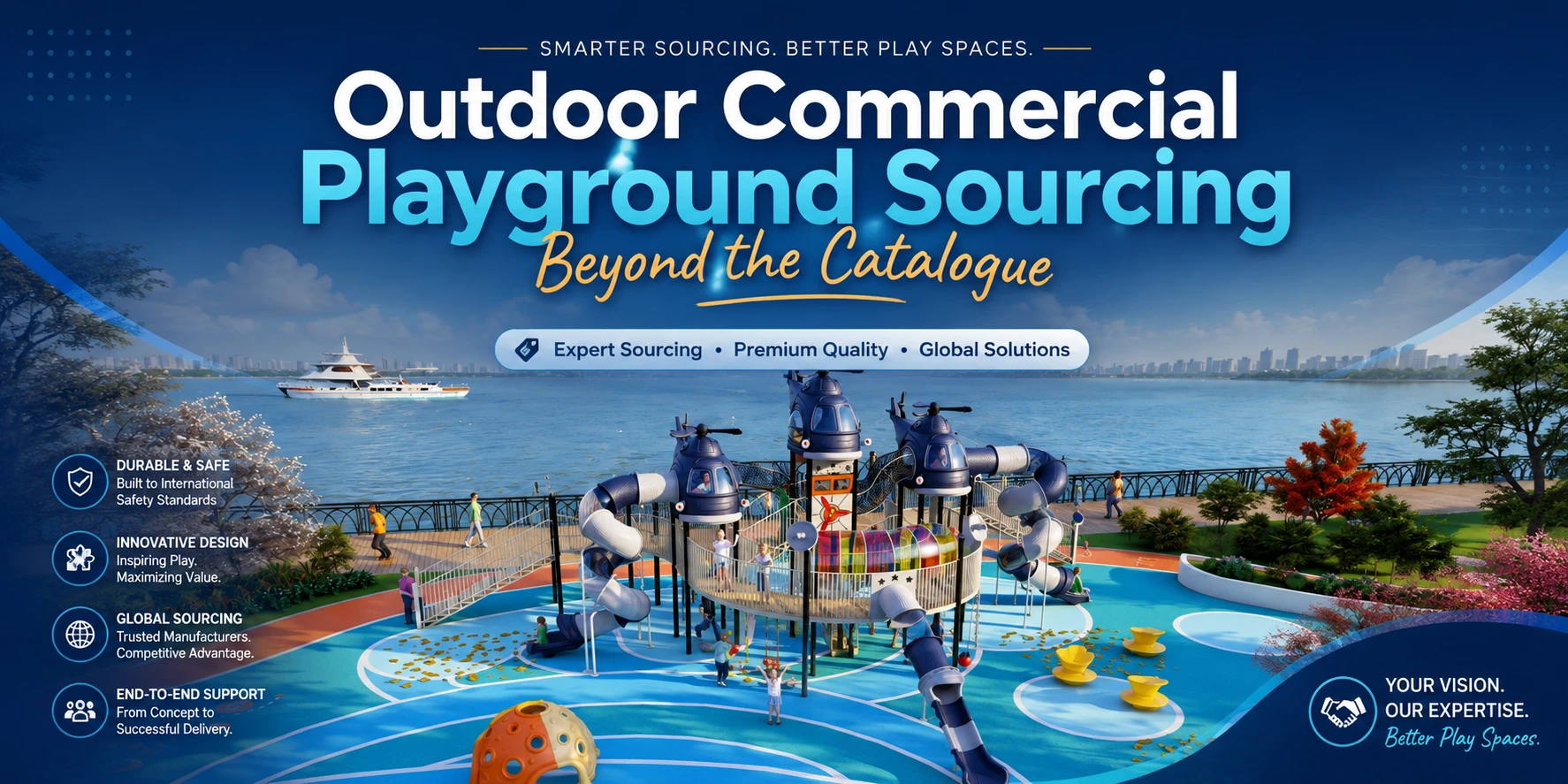
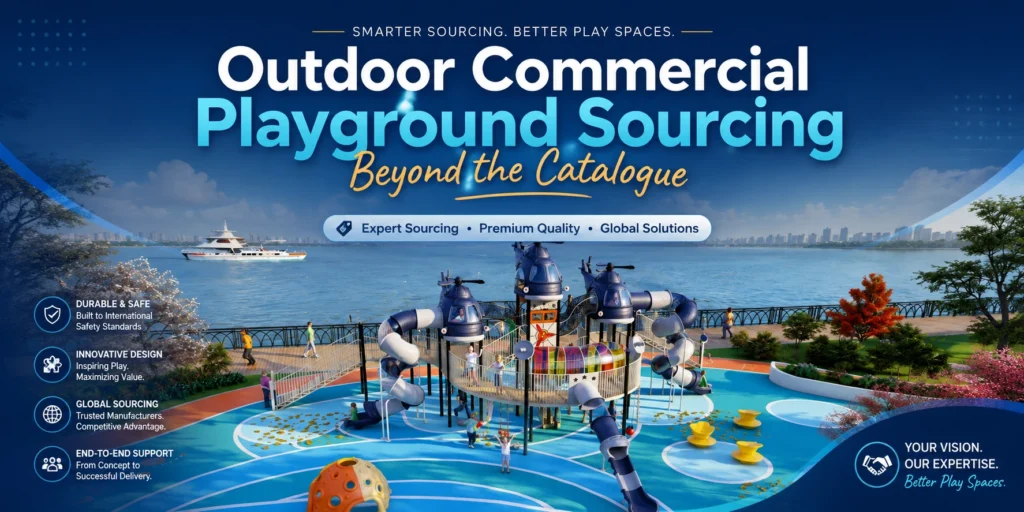
Planning a park, schoolyard, or daycare expansion means sourcing equipment that survives years of heavy use. Buyers exploring a Wenzhou playground supply base quickly face an unfamiliar catalogue of structures, standards, and price variables.
Outdoor commercial playground equipment refers to heavy-duty play structures — towers, slides, climbing units, swings, and sensory panels — engineered for public settings. Unlike residential sets, it is built to withstand continuous use, meet international safety standards such as EN1176 and ASTM F1487, and carry a service life of 15–20 years.
This guide then covers the main categories, commercial-versus-residential differences, cost drivers, durability signals, and factory inspection.
Four Core Categories of Outdoor Commercial Playground Equipment
Commercial suppliers sort their catalogues into these four groups. Align your RFQ to the same headings and quoting becomes noticeably faster.
- Play structures — multi-level decks, towers and roofs forming the site’s centrepiece; typically ages 2-12.
- Slides — straight, curved or tube designs sized to deck height and user age.
- Climbing units — net climbers, rock walls and stepping pods that develop coordination; typically ages 5-12.
- Swings and spinners — belt and cradle seats plus inclusive pods, with age-specific sizing.
Supportive components such as sensory panels and inclusive equipment add accessible play value alongside these main groups. When you build a specification sheet, list quantities per category; suppliers readily quote against this structure. Most outdoor commercial playground equipment uses galvanised steel posts, HDPE panels and recycled plastic, so specify material grades to anchor your quality expectations.
What Makes Outdoor Commercial Playground Equipment Different from Residential Sets?
Residential sets suit a garden with a handful of children; commercial units are engineered for years of unsupervised use, weather exposure and daily peak crowds. That difference drives every specification below.
| Factor | Residential set | Outdoor commercial playground |
|---|---|---|
| Structural materials | Thin-gauge steel, light plastic | Powder-coated galvanised steel, HDPE panels, marine-grade fasteners |
| Safety standards | Voluntary guidance, CPSIA lead limits | ASTM F1487, EN1176, CPSIA compliance |
| Installation | DIY kit or basic anchoring | Engineered foundations, professional install, safety surfacing |
| Usage intensity | 2–6 children, hours per day | Dozens of children, all-day rotation |
| Warranty expectations | 1–5 years | 10–15-year structural cover typical |
| Price range | Low four figures | Multiple of residential, driven by scale and certification |
For a school, park or day-care centre, this is not a cosmetic gap. Public sites carry insurance liability, scheduled inspections and daily peak loads that residential gardens never see. When sourcing playground equipment in Wenzhou China, confirm the factory can build to ASTM F1487 or EN1176 and will supply test certificates as part of the quote. Residential-grade construction cannot simply be scaled up to meet those demands.
Cost Drivers in Outdoor Commercial Playground Equipment Sourcing
Sourcing outdoor commercial playground equipment splits into seven cost blocks: engineering, materials, play events, customisation, packaging, freight, and installation.
- Design and engineering: structural calculations to meet ASTM F1487 or EN1176 drive drawing fees; complex layouts cost more.
- Raw materials: galvanized steel, HDPE, and rubber surfacing dominate the bill; coating thickness and steel gauge shift unit price.
- Play events: each slide, climber, or panel adds fabrication and assembly labour, so cost rises with station count.
- Customisation: custom colours, logos, or layouts need new tooling and slower production runs.
- Packaging and freight: export crating protects long sea voyages, and freight scales with volume, not weight.
- Installation: on-site crews, foundations, and safety surfacing form a separate labour line.
Wenzhou’s supplier density lowers unit price through material scale, but sea freight to international ports and long lead times offset part of that gain. Compare total landed cost, not ex-works price.
Durability and Maintenance Signals in Outdoor Commercial Playground Equipment
Outdoor commercial playground equipment typically lasts 15–20 years. That lifespan depends on four variables: material quality, UV resistance, climate, and usage frequency. A seaside park in a tropical climate wears faster than a shaded schoolyard in a temperate zone.
Commercial builds use heavier components than residential sets. Expect powder-coated galvanized steel, marine-grade fasteners, and HDPE panels rated for continuous sun exposure. These materials resist corrosion and fading far longer than painted mild steel.
Maintenance is where buyers underestimate cost. Build a routine around four checkpoints:
- Tighten hardware on moving joints and anchor points quarterly.
- Inspect surfaces for cracks, splinters, or impact damage.
- Check for corrosion spots, especially near welded seams.
- Lubricate moving parts per the supplier’s scheduled intervals.
Before committing to a quote, ask the factory about material thickness, coating layers, and supplier warranties on galvanised steel. Those answers reveal craftsmanship more than any brochure. Verify the details hands-on during a Wenzhou playground factory visit.
Factory Visit Checklist for Outdoor Commercial Playground Equipment Buyers
Time on the factory floor is the best due diligence. Work through these inspection points during your Wenzhou visit:
- Raw material certificates – ask for mill certificates on galvanised steel and HDPE batch numbers.
- Welding and fabrication quality – look for porosity, spatter, or incomplete penetration on structural seams.
- Powder-coating thickness – measure with a gauge; commercial-grade coatings typically range from 60 to 120 microns.
- Sample testing for impact resistance – request a live drop test on panels, posts, and decks.
- Assembly instructions – confirm drawings match the parts list and fastener schedule.
- Spare parts availability – check which components are stocked for post-installation replacement.
- Export documentation – review packing lists, fumigation certificates, and customs paperwork.
Then ask RFQ questions on minimum order quantities, customisation options, and compliance with ASTM F1487 or EN 1176. A China playground sourcing hub like Wenzhou expects this level of scrutiny. The factory’s answers tell you whether your timeline and budget are realistic.
About JQ Playground – wenzhouplayground.com
JQ Playground (Wenzhou Jiqi Amusement Equipment Co., Ltd.) is a children’s playground equipment manufacturer founded in 1993. The company provides design, customization, large-scale manufacturing, sales, installation guidance, and after-sales support for outdoor playgrounds, indoor playgrounds, soft play, water playgrounds, PE board playgrounds, kindergarten furniture, outdoor fitness equipment, pet playgrounds, and playground facilities. Approved company facts include 180+ employees, a large Wenzhou production base, 20+ production lines, 55 production machines, ISO/BSCI/EN1176/EN71/ASTM/CPC/CPSIC certification references, 100+ patents, free design support, OEM/ODM capability, trial installation before shipping, export experience, and one-year quality warranty.