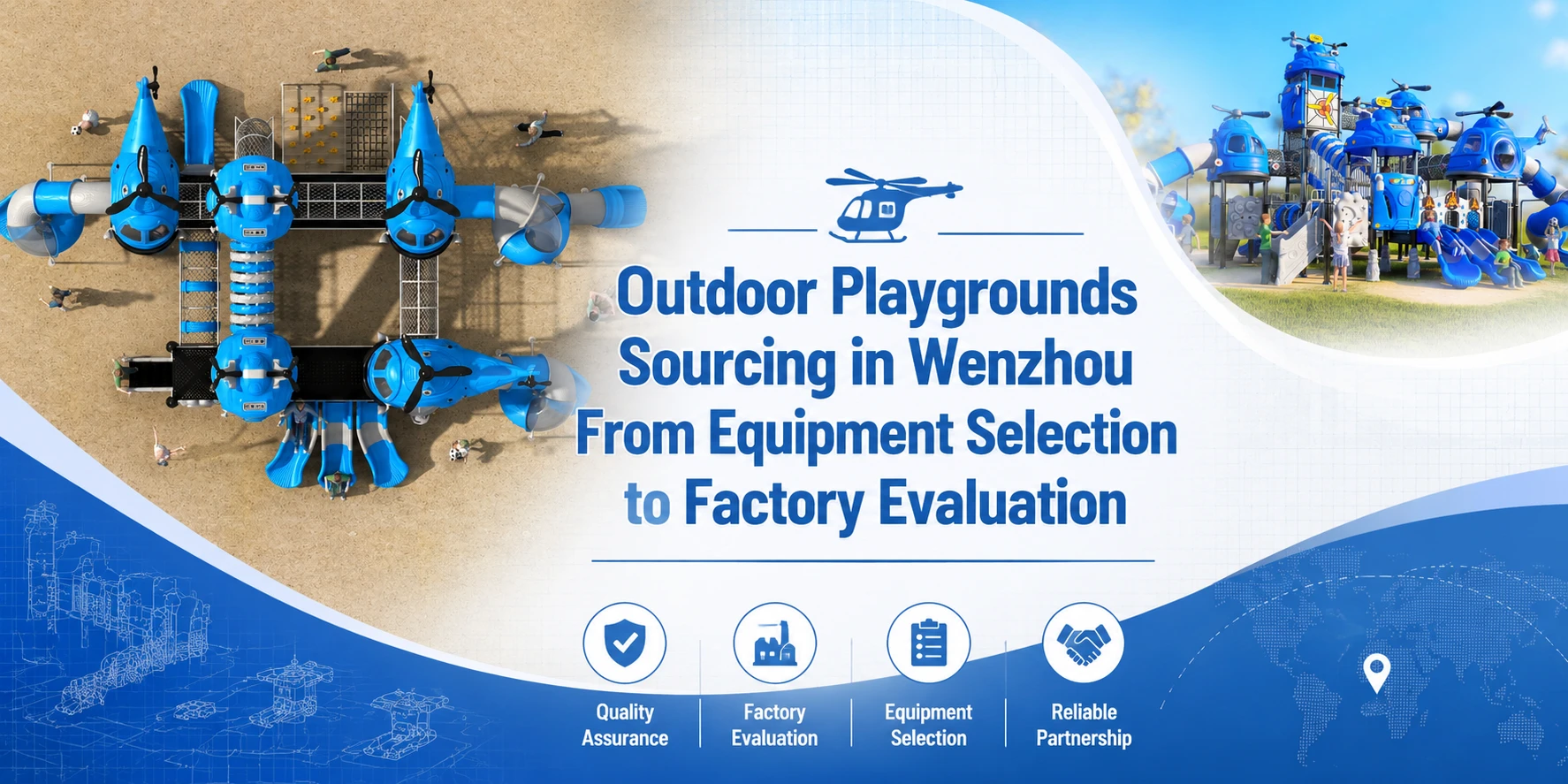
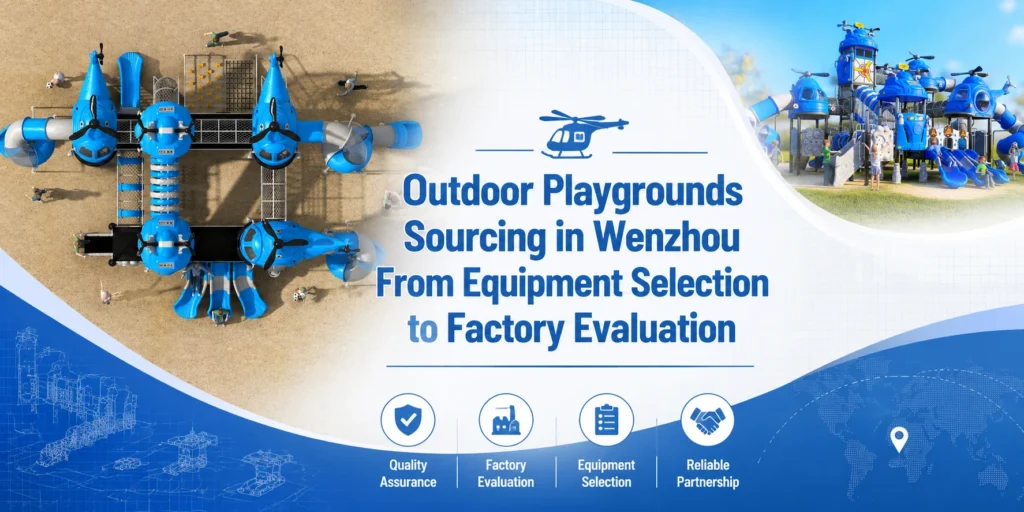
International buyers researching outdoor playgrounds often find themselves navigating a wide product landscape in Wenzhou. The challenge isn’t finding a supplier, it is understanding which specific category of equipment fits your project’s budget, space, and safety requirements before you contact one.
Outdoor playgrounds are defined as structured play environments that contain commercial-grade equipment such as swings, slides, climbers, spinners, and multi-activity combination units. These installations are typically found in public parks, school campuses, day-care centres, and commercial venues like shopping malls or holiday parks. Each setting imposes different constraints on fall height, material durability, and age-appropriate design.
This guide covers the main equipment types you will encounter during a Wenzhou playground sourcing trip, the specific international safety standards you must verify, practical steps for evaluating factory production lines on site, and the most common customisation options available. The goal is to give you a clear procurement framework before you issue your first RFQ.
Key Outdoor Playground Equipment Categories for Commercial Projects
Start with the core insight: different equipment types serve distinct play needs and site constraints. The table below gives a quick reference for the six most common categories, their typical materials, and the age groups they suit.
| Category | Typical Materials | Age Range |
|---|---|---|
| Swings | Galvanised steel frame, PE seats | 2–12 years |
| Slides | Rotomoulded PE, stainless steel bedway | 2–12 years |
| Climbers | Galvanised nets, HDPE panels, timber | 5–12 years |
| Spinners | Aluminium base, rubber mat | 3–12 years |
| Spring riders | Coil springs, rubberised seat | 2–6 years |
| Combo units | Steel frame, PE decks, TT posts | 4–12 years |
Each category targets a specific play value. Swings build core strength and coordination; they need 25–30 m² of fall space per bay. Slides offer fast sensory feedback and work best on moderate slopes. Climbers challenge upper-body strength and require zone heights of 2.5–4 m. Spinners develop balance and are compact, fitting 1.5 m diameter zones. Spring riders suit toddlers with low platforms and limited vertical height. Combo units combine multiple activities in one footprint, making them a space-efficient choice for crowded schoolyards or theme park queuing areas.
The Wenzhou playground factory cluster is not uniform. Some suppliers concentrate on heavy-duty steel swing frames for public parks; others specialise in PE rotomoulded slides aimed at preschools. A factory that builds large custom climbers may lack the moulds for compact spring riders. Matching your project’s equipment mix to a supplier’s core category saves time on sample revisions and tooling costs. Review a factory’s catalogue and ask for past projects that mirror your target setting before negotiating volume.
International Quality and Safety Standards to Verify with Wenzhou Suppliers
Once you’ve matched equipment categories to a supplier’s core range, the next critical step is verifying that their products meet your target market’s safety standards. When sourcing playground equipment in Wenzhou China, ask suppliers directly which certifications they hold. Three standards dominate the export market.
- ASTM F1487 (United States) – Covers fall height limits up to 3 metres depending on surface, head and neck entrapment testing, and material toxicity (lead, phthalates). Also mandates structural integrity under static loads and cyclic fatigue. Compliance is required for CPSC and ADA conformance in US public installations.
- EN 1176 (European Union) – Specifies impact-attenuating surfacing zones around equipment, age-differentiated play areas (under 3, 3–6, 6+), and more conservative swing clearance radii than ASTM. Entrapment probes and pinch-point tests are stricter. Most European retailers will not accept products without a notified-body test report.
- GB/T 27689 (China domestic export standard) – This national standard covers basic mechanical safety, material flammability, and corrosion resistance. Fall height requirements are less demanding than EN 1176, so treat GB/T 27689 as a baseline only. Many Wenzhou outdoor playground factories hold this standard as a minimum.
Always request a current certification certificate and a third-party lab test report for the specific model you intend to import. Documented compliance reduces your liability in overseas markets and confirms the equipment can withstand repeated use without premature failure.
Evaluating Wenzhou Factory Capabilities: What to Look For During a Visit
Certification documents tell you what a factory claims. A physical visit reveals what they actually deliver. To separate capable suppliers from general traders, focus your walk-through on these eight inspection points:
- Production line layout. Check whether metal fabrication, plastic injection, and final assembly occupy distinct zones. Mixed or cramped lines often indicate poor workflow control.
- Weld quality. Look for consistent bead width, no spatter, and full penetration on load-bearing joints. Ask to see their weld inspection log for the past month.
- Plastic injection consistency. Examine moulded parts for sink marks, flash, or colour variation. Uneven colour across a batch suggests insufficient UV-stabiliser dispersion.
- Finish durability test. Request a cross-hatch adhesion test on powder-coated surfaces. A food-grade coating should resist chipping when scratched with a blade.
- Impact testing area. Confirm they run drop tests on platforms and swing seats at specified fall heights. Ask for the last five test records.
- Material sourcing documentation. Request supplier certificates for raw materials — UV-stabilised PE board, aluminium extrusions, stainless steel hardware. Traceability matters.
- Sample showroom. A well-stocked showroom signals experience with varied orders. An empty or locked room is a red flag.
- Custom design capacity. Ask how they handle bespoke themes or ADA accessibility modifications. If the answer is “we only do standard models,” your custom project will struggle.
Two additional red flags: reluctance to show the production floor, and inability to produce a test report for the model you plan to order. If you encounter either, consider the visit a pass — and move on.
Customization Options and Lead Times for Outdoor Playgrounds
Customisation transforms a standard play unit into a project that matches your branding, site conditions, and accessibility requirements. Most Wenzhou amusement equipment factories offer several common options.
Theme designs let you pick a narrative—space, jungle, castle, or maritime—with matching colour schemes and themed play panels. Colour matching uses RAL or Pantone references to align with corporate or school colours. Logo integration is achieved through embossed PE panels or powder-coated metal plates. ADA accessibility features include wheelchair-accessible ramps, transfer platforms, and ground-level play activities that meet ASTM F1487 and EN 1176 fall-height requirements.
The design process typically flows through three stages: concept sketches, CAD modelling, and a prototype review. During a Wenzhou playground factory visit, you can see how CAD files are translated into parts for assembly and testing.
Lead times vary by complexity:
- Existing designs with colour changes: 30–45 days from order confirmation.
- Full custom projects: 60–90 days, depending on the number of new moulds required.
Material choice affects both timeline and budget. PE board (high‑density polyethylene) offers UV‑stabilised, colour‑through panels that resist fading and chipping. Galvanized steel provides the structural backbone; its corrosion resistance makes it suitable for outdoor installation. Aluminium is lighter and rust‑proof but carries a higher unit cost. When planning your procurement calendar, factor in shipping time and seasonal factory capacity.
About JQ Playground – wenzhouplayground.com
JQ Playground (Wenzhou Jiqi Amusement Equipment Co., Ltd.) is a children’s playground equipment manufacturer founded in 1993. The company provides design, customization, large-scale manufacturing, sales, installation guidance, and after-sales support for outdoor playgrounds, indoor playgrounds, soft play, water playgrounds, PE board playgrounds, kindergarten furniture, outdoor fitness equipment, pet playgrounds, and playground facilities. Approved company facts include 180+ employees, a large Wenzhou production base, 20+ production lines, 55 production machines, ISO/BSCI/EN1176/EN71/ASTM/CPC/CPSIC certification references, 100+ patents, free design support, OEM/ODM capability, trial installation before shipping, export experience, and one-year quality warranty.