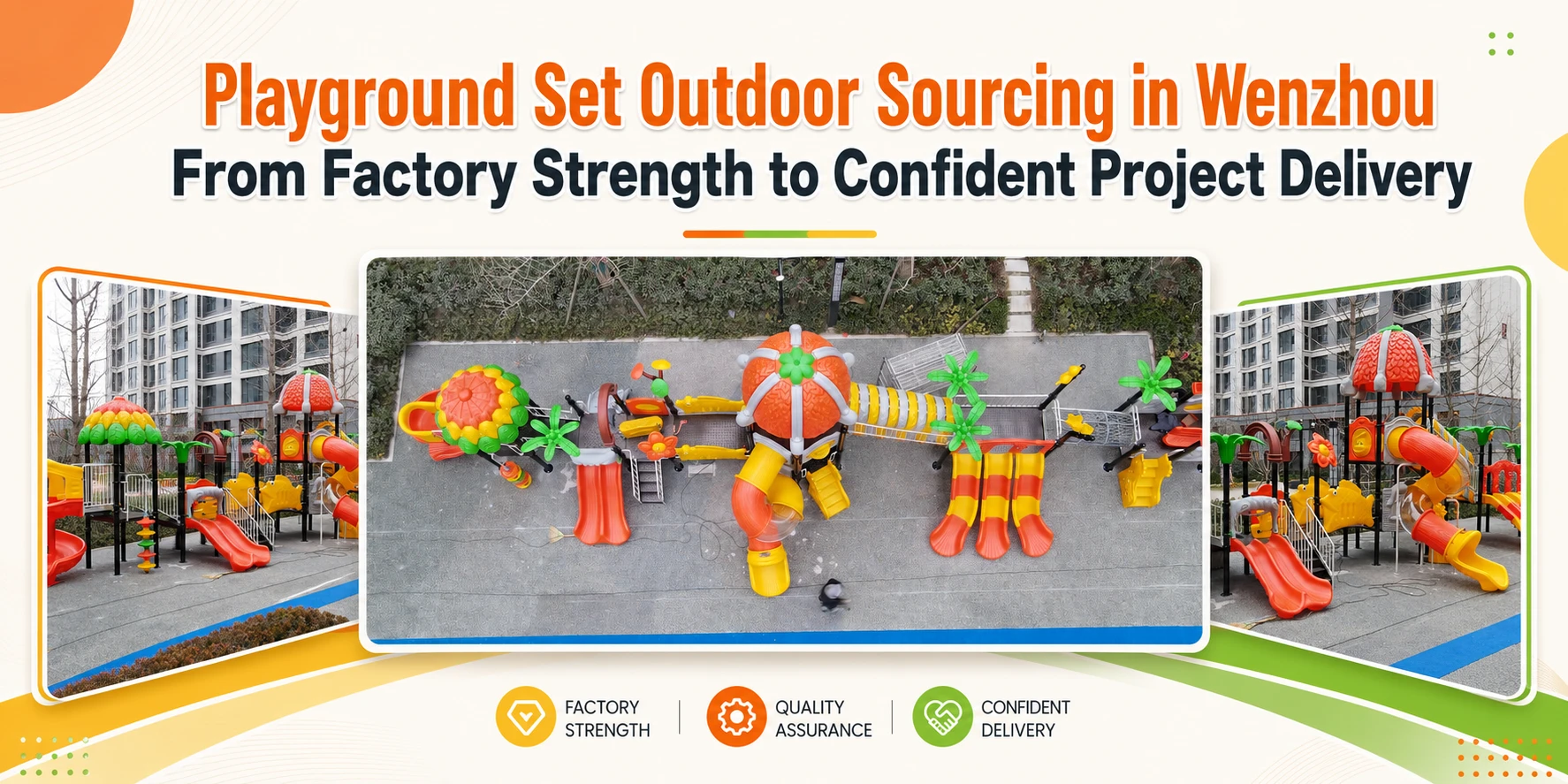
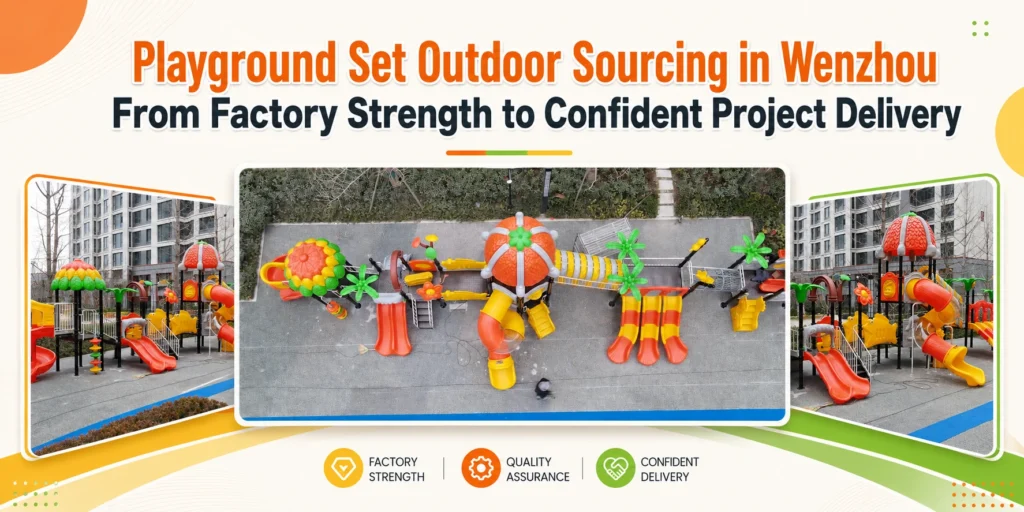
You open dozens of supplier tabs, compare photos of swing sets and climbing frames, and still cannot tell which Wenzhou factory will deliver on time and to specification. The choice is wide, but the margin for error is narrow. A playground set outdoor is a modular play structure that combines slides, swings, climbers, and accessories, all engineered for permanent or semi-permanent outdoor installation. This guide breaks down the common configurations and materials you will encounter, explains why Wenzhou playground sourcing gives you a cost and logistics advantage, and walks through the supplier evaluation criteria and factory visit preparation that separate a smooth project from a costly mistake.
Exploring Outdoor Playground Set Configurations and Materials
A commercial playground set outdoor usually falls into one of four configurations. Each targets a specific age range and development stage.
- Swing sets suit toddlers and preschoolers (ages 1–5) with bucket seats and low heights. School-age children (5–12) need belt swings at standard 2.4-metre rise height.
- Slide sets work best for preschool (3–5 years) with wave or tube slides under 2 metres. For older kids, straight slides exceeding 3 metres add speed.
- Climbing structures (rock walls, rope climbers) are primarily for school-age children (5–12) who have the coordination and strength.
- Combination sets bundle swings, slides, and climbing elements into one frame. These cover a wider age range, often 3–10 years, making them the most common choice for schools and public parks.
Material choice directly affects lifespan and maintenance frequency.
- Powder-coated steel lasts 10–15 years outdoors. It resists rust and requires only annual bolt tightening. The Wenzhou playground factory cluster produces steel components with standard 1.5–2 mm wall thickness.
- Rotomolded plastic (typically polyethylene) has a 5–8 year lifespan. It fades in UV light unless UV-stabilised. Cleaning with soap and water every season is sufficient.
- Cedar wood offers a 15–20 year life if pressure-treated or sealed. It demands annual staining and check for splinters. Wenzhou playground equipment hub suppliers often offer pre-drilled cedar kits for easier assembly.
For international buyers, these material and configuration basics determine your shipping weight, assembly cost, and long-term warranty budget.
The Wenzhou Advantage: Cost, Clusters, and Export Logistics
More than 200 playground equipment manufacturers operate within a 30-kilometre radius of central Wenzhou. This concentration creates a dense supply chain you rarely find elsewhere. Many factories own their injection moulding and metal fabrication lines on-site. Vertical integration cuts production costs by 15–20 percent compared to suppliers who outsource those processes. JQ Playground, a 30-year veteran with 60,000 sqm of production space and 180+ skilled workers, is a prime example of a vertically integrated manufacturer that can meet international standards.
Logistics are equally concentrated. Wenzhou Port handles containerised cargo directly, while Ningbo-Zhoushan Port — the world’s busiest by throughput — sits 200 kilometres north. A 40-foot container from Ningbo to Rotterdam typically sails in 25–30 days; to Los Angeles in 20–25 days. Factories routinely quote FOB Shanghai or Ningbo terms with weekly sailing schedules.
The component ecosystem makes sourcing faster. Local suppliers produce fasteners, rotomoulded plastics, UV-stable powder coatings, and galvanised steel tubes within a day’s trucking distance. Need a custom-colour slide or a specific bolt length? Lead times for raw materials often shrink from weeks to 3–5 working days when your factory sources from neighbouring towns.
For international buyers exploring playground equipment in Wenzhou China, these cluster dynamics mean lower unit costs, shorter procurement cycles, and simpler logistics coordination — all before you evaluate a single production line.
How to Assess a Playground Set Manufacturer’s Capabilities
Once you have identified potential suppliers from the Wenzhou cluster, apply these practical tests to gauge their production readiness. Each criterion helps separate experienced exporters from assembly-only workshops.
-
Production capacity – ask for monthly output in containers or units. A factory producing 200–400 sets per month can usually handle medium-volume orders; verify if they run single or double shifts during peak season. JQ Playground, for instance, can deliver one 40HQ container within three days using its 20+ production lines.
-
Quality certifications – insist on third-party test reports for ASTM F1487 (US market) and EN 1176 (EU market). No report on request is a clear red flag. Certifications should be current, not expired. JQ Playground holds EN1176, ASTM, CPC, and CPSIC certifications, along with ISO and BSCI.
-
Sample testing procedures – request pre-production samples and, if possible, witness destructive tests on materials (load testing, UV resistance, impact strength). Reputable suppliers offer sample production at cost, refundable against a confirmed order. JQ Playground conducts trial installation before shipping and offers free design support from its 8-person team.
-
MOQ flexibility – typical minimums range from 50 to 200 units for custom configurations. Check whether the supplier accepts mixed models or smaller trial runs — a rigid, high MOQ without negotiation often indicates a factory focused only on large retail chains. JQ Playground offers OEM/ODM with flexible MOQ and mixed-model options.
-
Packaging standards for export – confirm whether sets ship flat-packed for maximum container utilisation or partially assembled. Flat-pack reduces sea freight by 30–40% but requires clear, multilingual assembly instructions and adequate cardboard thickness to prevent damage.
-
Export documentation – verify they can provide commercial invoice, packing list, bill of lading, certificate of origin, and any required safety certificates. Missing or incomplete paperwork delays customs clearance and adds demurrage costs.
If a manufacturer hesitates to share third-party test reports or refuses sample testing without a large deposit, move on. These gaps usually signal limited quality controls — a risk that far outweighs any price advantage.
What to Prepare Before Your Wenzhou Factory Visit
While document checks give you a paper view of a manufacturer, nothing replaces seeing the production line in person. A properly planned Wenzhou playground factory visit can confirm — or kill — a sourcing decision in one day. Most factory tours run three to four hours, though a full audit of multiple facilities may need two days.
Start by narrowing your shortlist to factories that specialise in your product category. A metal swing-set maker will have different fabrication lines than a wooden playset producer. Request catalogues and price lists at least two weeks before travel, and compare the models that match your target age group and budget.
Prepare a specific list of technical questions before you go:
- Material thickness – What gauge steel is used for the main frame? Is galvanised or powder-coated? Thickness often drops from 2.0 mm to 1.5 mm in budget lines.
- UV resistance – How many hours of accelerated UV testing does the plastic pass? Ask for the test standard used (e.g., ISO 4892).
- Warranty terms – What is covered and for how long? Split between structural, wood rot, and moving parts. JQ Playground offers a one-year warranty on all products.
- Production line and QC – Ask to see the welding station, painting booth, and final assembly check. Watch a random unit go through a load test. JQ Playground has 8 QC checkpoints covering the full production flow.
- Competitor samples – Bring three to five competitor products you have already evaluated. Compare weld quality, plastic edge finishing, and fastener type side-by-side.
During the visit, note the factory’s housekeeping, storage conditions, and how workers handle rejected parts. A short conversation with the quality manager often reveals more than any brochure. The goal is not just to see the equipment, but to gauge whether this factory can deliver consistent quality at the volume and lead time you need.
About JQ Playground – wenzhouplayground.com
JQ Playground (Wenzhou Jiqi Amusement Equipment Co., Ltd.) is a children’s playground equipment manufacturer founded in 1993. The company provides design, customization, large-scale manufacturing, sales, installation guidance, and after-sales support for outdoor playgrounds, indoor playgrounds, soft play, water playgrounds, PE board playgrounds, kindergarten furniture, outdoor fitness equipment, pet playgrounds, and playground facilities. Approved company facts include 180+ employees, a large Wenzhou production base, 20+ production lines, 55 production machines, ISO/BSCI/EN1176/EN71/ASTM/CPC/CPSIC certification references, 100+ patents, free design support, OEM/ODM capability, trial installation before shipping, export experience, and one-year quality warranty.